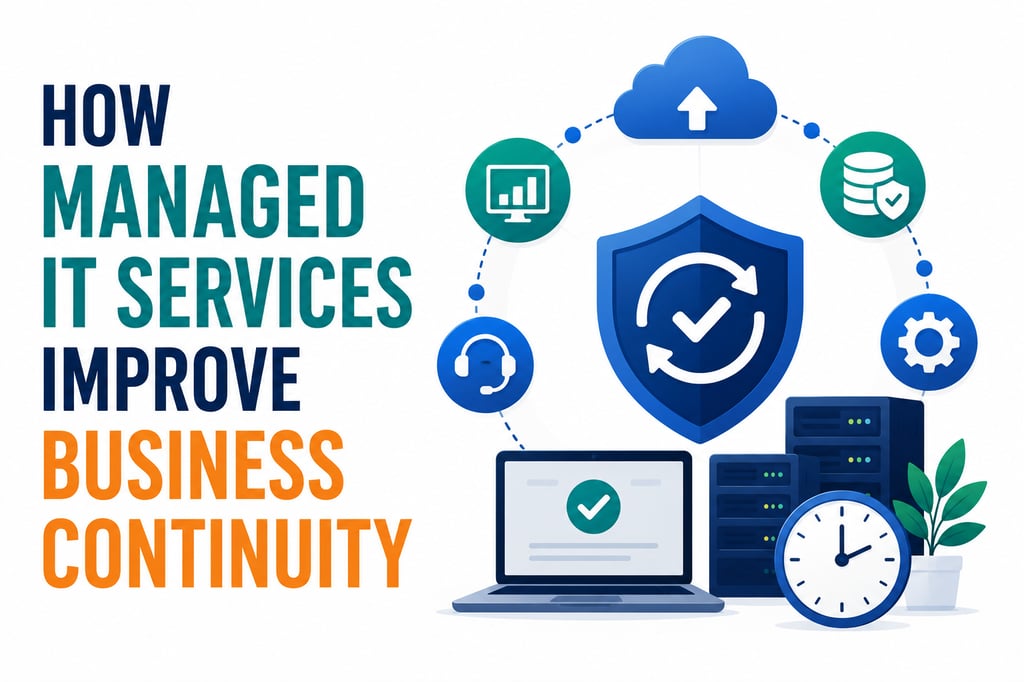
How Managed IT Services Improve Business Continuity
Business continuity is critical in today’s always-connected digital environment. This article explains how managed IT services help businesses minimize downtime, strengthen disaster recovery, improve system reliability, and maintain operational stability during unexpected disruptions such as cyberattacks, hardware failures, or outages.
5/18/20264 min read
In today’s technology-driven business environment, operational continuity has become a critical requirement for organizations of all sizes. Businesses depend heavily on digital systems for communication, collaboration, customer service, financial operations, cloud applications, and data management.
Even short periods of downtime can result in significant operational disruption, financial losses, and reputational damage.
As cyber threats increase and IT environments become more complex, businesses are recognizing that traditional reactive IT support is no longer enough to ensure operational stability. Organizations now require proactive systems, continuous monitoring, reliable backups, and structured disaster recovery strategies to maintain uninterrupted operations.
This is where managed IT services play a vital role.
Managed Service Providers (MSPs) help businesses strengthen business continuity by proactively managing IT infrastructure, reducing operational risk, improving recovery capabilities, and ensuring technology environments remain stable, secure, and resilient.
What Is Business Continuity?
Business continuity refers to an organization’s ability to continue operating during and after unexpected disruptions.
These disruptions may include:
Cyberattacks
Ransomware incidents
Hardware failures
Internet outages
Power failures
Human error
Data corruption
Natural disasters
Cloud service disruptions
A strong business continuity strategy ensures that critical systems, applications, and data remain available or can be restored quickly with minimal business impact.
The primary goal is to reduce downtime and maintain essential operations during unexpected events.
Why Business Continuity Is Critical for Modern Businesses
Modern businesses operate in highly connected environments where nearly every operational process depends on technology.
Examples include:
Email communication
Cloud collaboration platforms
Customer databases
Financial systems
Remote access
Online services
Inventory management
Internal business applications
When these systems become unavailable, business operations can slow down or stop entirely.
Business continuity has therefore become directly connected to:
Revenue protection
Customer trust
Employee productivity
Regulatory compliance
Brand reputation
Operational efficiency
For growing businesses, even a few hours of downtime can create serious operational and financial consequences.
The Common Risks That Threaten Business Continuity
Cybersecurity Threats
Ransomware and cyberattacks remain one of the biggest threats to business continuity.
A successful ransomware attack can:
Encrypt critical business data
Disable servers and endpoints
Prevent employee access
Interrupt customer services
Cause prolonged downtime
Businesses without proper security controls and recovery strategies often struggle to restore operations quickly.
Hardware and Infrastructure Failures
Servers, storage devices, networking equipment, and employee devices can fail unexpectedly.
Without redundancy and recovery planning, hardware failures may result in:
Data loss
Service outages
Operational delays
Extended recovery times
Human Error
Accidental deletion of files, incorrect configurations, or mismanaged updates can disrupt business operations.
Human error remains one of the most common causes of downtime and data loss.
Lack of Backup Verification
Many businesses assume backups are functioning correctly simply because backup software is installed.
However, without proper monitoring and testing:
Backups may fail silently
Recovery processes may not work
Data may become corrupted
Critical systems may not restore properly
Businesses often discover backup issues only during emergencies.
How Managed IT Services Strengthen Business Continuity
Managed IT services focus on proactive prevention, monitoring, recovery planning, and operational resilience.
Instead of waiting for failures to occur, MSPs continuously manage systems to minimize risk and improve recovery readiness.
Proactive Monitoring and Early Issue Detection
One of the biggest advantages of managed IT services is continuous monitoring.
MSPs monitor:
Servers
Networks
Endpoints
Cloud environments
Backup systems
Security alerts
Infrastructure performance
This allows potential problems to be identified before they become major outages.
Examples include:
Detecting failing hardware
Identifying unusual network activity
Monitoring storage capacity
Detecting backup failures
Responding to security threats early
Proactive monitoring significantly reduces the likelihood of unexpected downtime.
Reliable Backup Management
Backups are a foundational component of business continuity.
Managed IT providers help businesses implement structured backup strategies that include:
Automated backups
Cloud backups
Offsite backups
Backup monitoring
Data retention policies
Backup encryption
Recovery testing
A well-managed backup system ensures critical business data can be restored quickly when needed.
MSPs also verify backup integrity regularly to ensure backups remain usable during emergencies.
Disaster Recovery Planning
Business continuity is not only about backups — it also requires a clear recovery strategy.
Managed IT services help businesses develop disaster recovery plans that define:
Recovery procedures
System restoration priorities
Recovery time objectives (RTO)
Recovery point objectives (RPO)
Emergency response workflows
Communication procedures
A structured recovery plan helps businesses restore operations faster and more efficiently during incidents.
Cybersecurity Protection
Strong cybersecurity directly supports business continuity.
Modern MSPs implement multiple security layers such as:
Endpoint protection
Firewall management
Multi-Factor Authentication (MFA)
Email security
Vulnerability management
Threat monitoring
Patch management
Access controls
By reducing the likelihood of successful cyberattacks, businesses improve overall operational stability and reduce downtime risk.
Cloud and Remote Work Resilience
Cloud technologies play an important role in modern business continuity strategies.
Managed IT providers help businesses leverage cloud services to improve resilience through:
Cloud-based collaboration tools
Remote access solutions
Cloud backups
Geographic redundancy
High availability environments
Cloud-based systems often allow employees to continue working even during local office disruptions.
This became especially important during global events such as the COVID-19 pandemic, where businesses needed to rapidly support remote operations.
Patch Management and System Maintenance
Outdated systems and unpatched software create both security and operational risks.
Managed IT providers continuously maintain systems through:
Software updates
Security patching
Firmware updates
Performance optimization
Preventive maintenance
This reduces vulnerabilities and improves infrastructure stability.
Preventive maintenance helps avoid avoidable outages caused by software failures or compatibility issues.
Reduced Downtime and Faster Recovery
Business continuity depends heavily on how quickly systems can recover after disruptions.
Managed IT services improve recovery speed through:
Automated monitoring
Predefined recovery processes
Centralized management tools
Rapid troubleshooting
Remote support capabilities
Faster response times help minimize operational impact during incidents.
Strategic IT Planning for Long-Term Stability
Managed IT providers also help businesses improve long-term resilience through strategic planning.
This may include:
Infrastructure modernization
Network redesign
Cloud migration planning
Security improvements
Scalability planning
Technology standardization
Strategic IT planning helps businesses build stable, scalable, and resilient technology environments that support future growth.
Business Continuity Is No Longer Optional
Modern customers expect businesses to operate reliably and securely at all times.
Extended downtime can result in:
Lost revenue
Reduced customer confidence
Contractual penalties
Compliance issues
Reputational damage
As technology dependence continues to increase, business continuity is becoming a core business requirement rather than simply an IT concern.
Organizations that invest in proactive continuity planning are better positioned to handle disruptions while maintaining operational stability.
Conclusion
Business continuity is essential for organizations operating in today’s digital business landscape. Cyber threats, system failures, human error, and operational disruptions can impact businesses at any time, making proactive IT management more important than ever.
Managed IT services help businesses strengthen continuity through proactive monitoring, reliable backups, disaster recovery planning, cybersecurity protection, cloud resilience, and strategic IT management.
Rather than reacting to problems after they occur, modern MSPs help businesses prevent disruptions, minimize downtime, and recover quickly when incidents happen.
For growing businesses, managed IT services provide the operational stability, resilience, and technology support needed to maintain continuity and support long-term success.
Eden IT Solutions
Modern IT Management for Growing Businesses
Microsoft 365 Administration
© 2026 Eden IT Solutions. All Rights Reserved.
Supporting businesses across UAE, UK, Singapore & India.
Our Approach
AI Business Solutions
About Eden IT Solutions
Why Choose Us
Industries We Support
Client Testimonials
Managed IT Support
Cloud & AWS Management
AI-powered IT Automation
Remote Workforce Solutions
Cloud Migration Services
IT Infrastructure Optimization
Contact Us
Cybersecurity & Endpoint Protection
Backup & Disaster Recovery
Network & Server Management
24x7 IT Monitoring
Business Continuity Planning
Security Assessments
Get a Consultation
Support
Service Locations
Privacy policy
Terms & Conditions
Cookie Policy