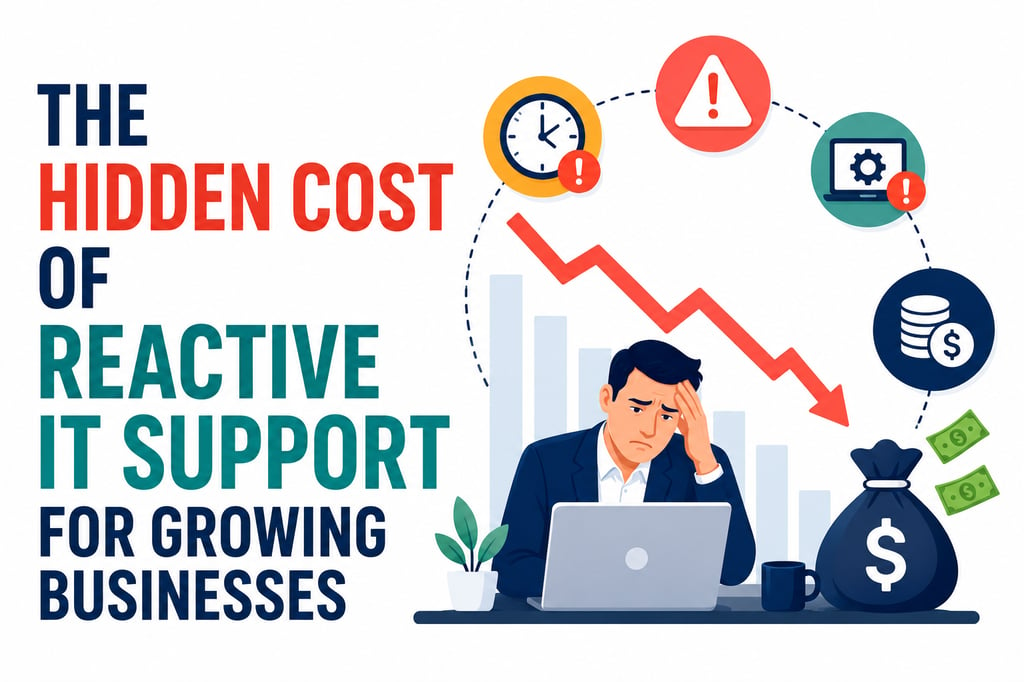
The Hidden Cost of Reactive IT Support for Growing Businesses
Many growing businesses still rely on reactive “break-fix” IT support without realizing the long-term operational and financial risks involved. This article explores the hidden costs of downtime, productivity loss, cybersecurity exposure, and unpredictable IT expenses — and explains why proactive managed IT services have become essential for modern business growth.
5/18/20264 min read
As businesses grow, their reliance on technology increases significantly. From communication and collaboration to customer management, cloud applications, cybersecurity, and daily operations, technology has become deeply integrated into every aspect of business success.
However, many small and medium-sized businesses (SMBs) continue to operate under a reactive IT support model — commonly known as “break-fix” support. In this model, IT issues are addressed only after they occur. Businesses contact an IT provider when systems fail, users experience problems, or downtime disrupts operations.
While this approach may initially appear cost-effective, the long-term financial and operational consequences can be substantial.
Modern businesses can no longer afford extended downtime, security vulnerabilities, or unpredictable IT disruptions. As technology environments become more complex, reactive IT support often creates hidden costs that negatively impact productivity, security, customer experience, and business growth.
What Is Reactive IT Support?
Reactive IT support follows a simple approach:
Something breaks
Business operations are disrupted
IT support is contacted
The issue is fixed afterward
This model is commonly referred to as break-fix IT support because support is only provided when a problem occurs.
Examples include:
Server crashes
Email outages
Network failures
Slow computers
Malware infections
Backup failures
Printer or connectivity issues
While reactive support may work temporarily for very small environments, it becomes increasingly risky as businesses scale operations and depend more heavily on technology.
The True Hidden Costs of Reactive IT Support
Many businesses only calculate direct IT repair expenses when evaluating support costs. However, the largest financial losses often come from indirect operational impact.
Downtime and Lost Productivity
One of the biggest hidden costs of reactive IT support is business downtime.
When critical systems fail unexpectedly:
Employees cannot work efficiently
Customer service is interrupted
Internal communication slows down
Sales activities may stop completely
Remote users lose access to systems
Business operations become delayed
Even a short outage can impact dozens of employees simultaneously.
For growing businesses, downtime often results in:
Missed deadlines
Delayed projects
Reduced employee productivity
Revenue loss
Customer dissatisfaction
In many cases, the actual business loss during downtime is far greater than the IT repair cost itself.
Unpredictable IT Expenses
Reactive support creates inconsistent and unpredictable IT spending.
Businesses operating under break-fix models often face:
Emergency support charges
Unexpected hardware replacement costs
Urgent repair expenses
After-hours support fees
Recovery costs after failures
This makes budgeting difficult and creates financial uncertainty.
Instead of strategically planning IT investments, businesses are forced into emergency spending whenever critical issues arise.
Growing organizations typically require predictable operational costs to scale effectively. Reactive IT environments rarely provide that stability.
Increased Cybersecurity Risk
Reactive IT environments often lack proactive security monitoring and maintenance.
This creates major cybersecurity risks such as:
Unpatched systems
Outdated software
Weak endpoint protection
Misconfigured firewalls
Poor password policies
Backup failures
Undetected malware infections
Cybercriminals actively target businesses with weak security controls because they are easier to compromise.
Without proactive monitoring and threat detection, businesses may remain unaware of security breaches for extended periods.
A single ransomware attack can result in:
Operational shutdown
Data loss
Financial damage
Recovery expenses
Reputational harm
Compliance violations
For many SMBs, recovering from a major cyberattack can take weeks or even months.
Reduced Employee Efficiency
Frequent IT disruptions create frustration across the organization.
Employees dealing with slow systems, recurring technical issues, or unstable applications often experience:
Reduced productivity
Delayed workflows
Lower morale
Increased dependency on manual processes
Communication difficulties
As businesses grow, recurring technical inefficiencies compound over time.
Even seemingly minor issues such as slow login times, unstable Wi-Fi, or application crashes can collectively result in hundreds of lost productivity hours annually.
Lack of Strategic IT Planning
Reactive support models typically focus only on fixing immediate problems.
There is often little emphasis on:
Long-term infrastructure planning
Technology modernization
Security improvements
Cloud optimization
Capacity planning
Business continuity strategies
As a result, businesses frequently operate with outdated systems that become harder and more expensive to maintain over time.
Without strategic guidance, organizations may also adopt technologies inefficiently or fail to align IT investments with business growth goals.
Backup Failures Often Go Undetected
Many businesses assume backups are functioning correctly simply because backup software is installed.
However, reactive IT models rarely include:
Backup monitoring
Recovery testing
Storage validation
Disaster recovery planning
This creates dangerous situations where businesses discover backup failures only after a major incident occurs.
In the event of ransomware, accidental deletion, or hardware failure, unsuccessful backups can lead to permanent data loss and extended downtime.
Poor Scalability for Growing Businesses
As businesses expand, IT environments become more complex.
New requirements may include:
Additional users
Remote workforce support
Cloud infrastructure
Security compliance
Collaboration platforms
Network expansion
Device management
Reactive IT support struggles to scale efficiently because it lacks proactive planning and infrastructure optimization.
This often results in:
Performance bottlenecks
Network instability
Increased outages
Security gaps
Operational inefficiencies
Growing businesses require IT systems that can scale reliably alongside business operations.
Customer Experience Is Directly Impacted
Technology disruptions do not only affect internal employees — they also affect customers.
Examples include:
Delayed responses
Inaccessible services
Slow communication
Failed transactions
Reduced service reliability
In competitive industries, repeated service interruptions can damage customer trust and reputation.
Modern customers expect businesses to operate with reliability, speed, and professionalism. Unstable IT systems directly undermine that expectation.
The Shift Toward Proactive Managed IT Services
To address these challenges, many SMBs are moving away from reactive support and adopting proactive managed IT services.
Unlike break-fix support, managed IT services focus on prevention rather than reaction.
This includes:
24x7 monitoring
Automated alerts
Patch management
Cybersecurity management
Backup monitoring
Performance optimization
Preventive maintenance
Strategic IT planning
The goal is to identify and resolve issues before they impact business operations.
Benefits of Proactive IT Management
Businesses that transition to managed IT services typically experience:
Reduced Downtime
Continuous monitoring helps identify issues early before they become critical outages.
Predictable Monthly Costs
Fixed monthly pricing improves budgeting and financial planning.
Improved Cybersecurity
Proactive security management reduces exposure to cyber threats.
Better Employee Productivity
Reliable systems help employees work more efficiently.
Faster Technical Support
Dedicated support teams resolve issues quickly and consistently.
Long-Term IT Strategy
Businesses gain guidance for future growth and technology investments.
Modern IT Is a Business Investment
Technology is no longer simply an operational necessity — it has become a critical business driver.
Reliable IT infrastructure enables businesses to:
Scale operations efficiently
Improve customer service
Protect sensitive data
Support remote work
Maintain operational continuity
Stay competitive
Organizations that continue relying solely on reactive IT support often face increasing operational risk as they grow.
Conclusion
Reactive IT support may appear cost-effective initially, but the hidden operational, financial, and security costs can become significant over time.
Downtime, productivity loss, cybersecurity vulnerabilities, unexpected expenses, and poor scalability all impact business growth and stability.
Modern SMBs increasingly recognize that proactive managed IT services provide a more reliable, secure, and strategic approach to technology management.
By shifting from reactive support to proactive IT management, businesses can reduce operational risk, improve efficiency, strengthen cybersecurity, and create a stable technology foundation for long-term growth.
Eden IT Solutions
Modern IT Management for Growing Businesses
Microsoft 365 Administration
© 2026 Eden IT Solutions. All Rights Reserved.
Supporting businesses across UAE, UK, Singapore & India.
Our Approach
AI Business Solutions
About Eden IT Solutions
Why Choose Us
Industries We Support
Client Testimonials
Managed IT Support
Cloud & AWS Management
AI-powered IT Automation
Remote Workforce Solutions
Cloud Migration Services
IT Infrastructure Optimization
Contact Us
Cybersecurity & Endpoint Protection
Backup & Disaster Recovery
Network & Server Management
24x7 IT Monitoring
Business Continuity Planning
Security Assessments
Get a Consultation
Support
Service Locations
Privacy policy
Terms & Conditions
Cookie Policy